LONGEVITY TESTING

Gait - How The Way You Walk Predicts Your Longevity
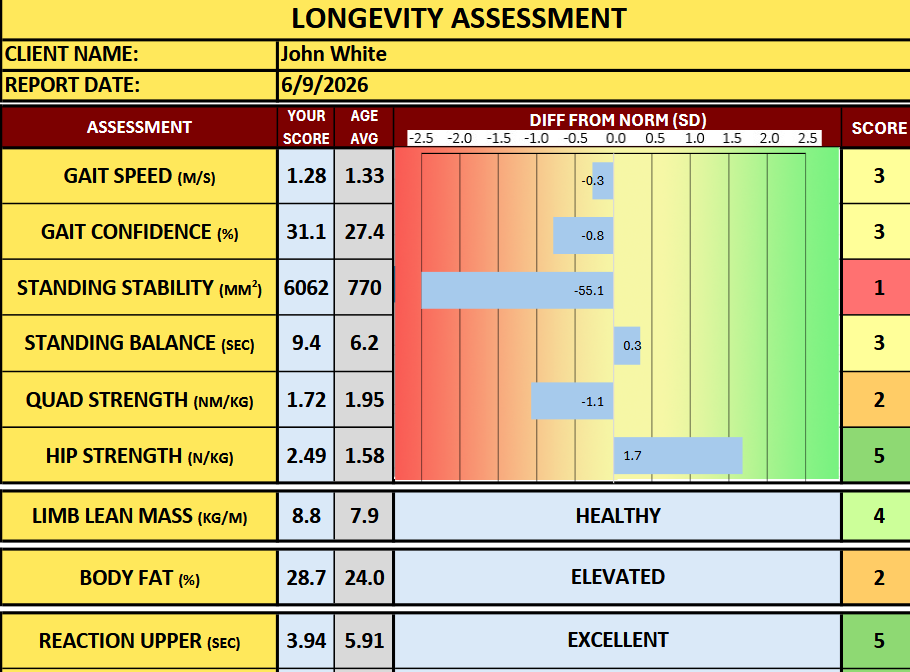
It sounds almost too simple, but gait speed — literally, how fast you walk — is one of the most well-studied predictors of longevity in the aging research literature. A landmark pooled analysis of 34,485 older adults found that every 0.1 meter-per-second increase in gait speed was associated with a 12% lower risk of death, a relationship that held consistently across nine separate long-term studies (Studenski et al., JAMA, 2011). Few single measurements in aging research carry that much predictive power.
Gait isn't just speed, though — it reflects the combined output of strength, balance, joint mobility, and neuromuscular coordination all working together in real time, which is part of why it's such a strong composite signal of overall function.

How It's Measured
Clinical gait analysis uses instrumented treadmills with pressure-sensing plates (Zebris-style systems are common) to capture short bouts of walking and break down step symmetry, stride length, and walking speed with far more precision than a stopwatch and a hallway.
Why It's A Cornerstone Assessment
Because gait integrates so many other systems, changes in gait speed are often one of the earliest visible signs that something else — strength, balance, joint health — is starting to decline, which makes it a useful early-warning marker as much as a standalone score.
To learn more about gait testing and to schedule a test, click below!